
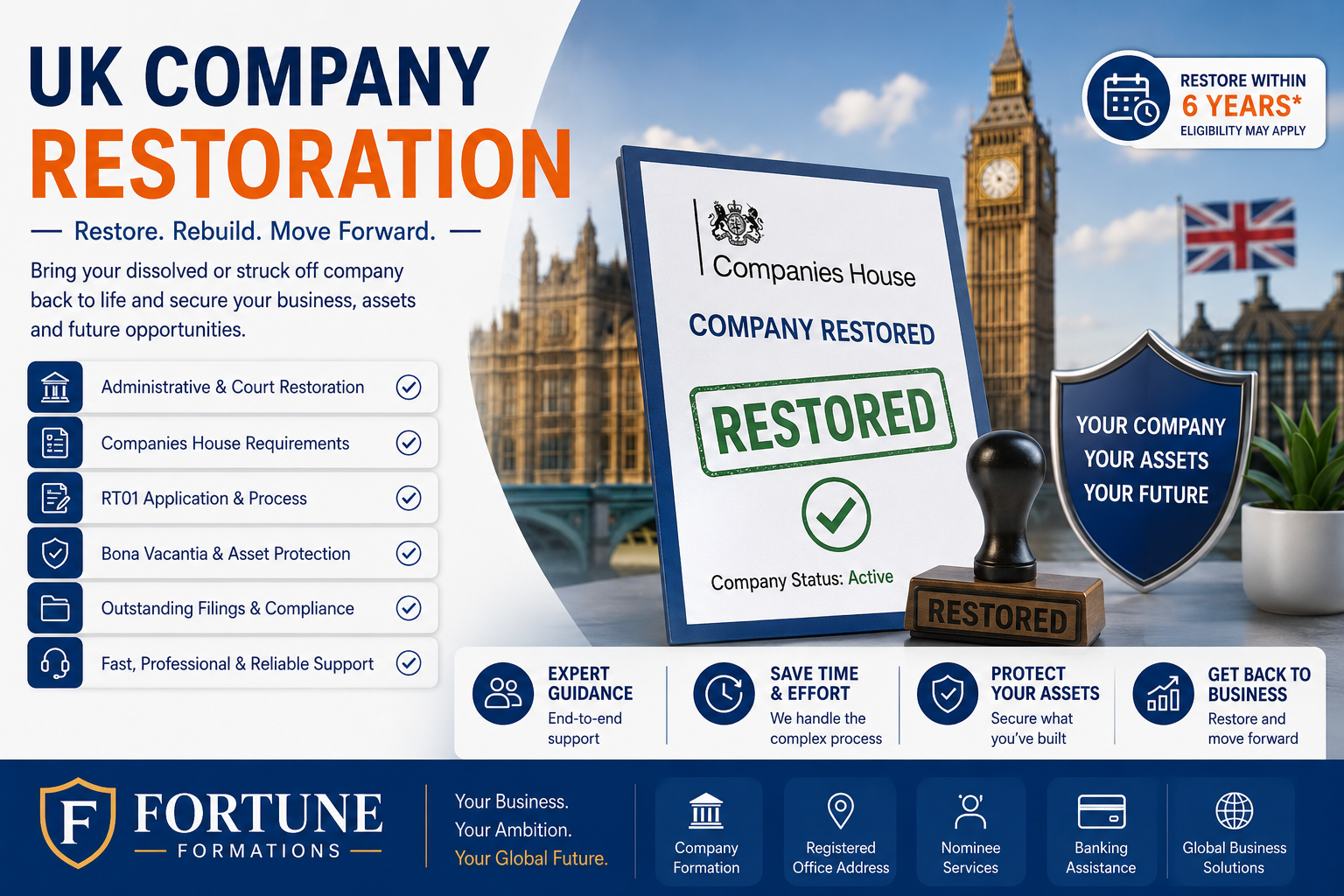
Discovering that your UK company has been dissolved or struck off the Companies House register can create serious problems—especially when the company still has a business bank account, assets, contracts, intellectual property, outstanding payments or an operating business behind it.
The important thing to understand is that dissolution does not always mean the end of your company.
Depending on why and when the company was dissolved, it may be possible to restore it to the Companies House register.
However, company restoration is very different from forming a new company. There are eligibility conditions, outstanding filings, penalties, Companies House requirements and, in some situations, court proceedings to consider.
What Is UK Company Restoration?
Company restoration is the legal process of returning a dissolved company to the Companies House register.
When restoration is successful, the company is generally treated as having continued in existence as though it had not been dissolved or struck off.
This can be extremely important where the dissolved company previously held:
- Business funds
- Property
- Intellectual property
- Contracts
- Receivables
- Other company assets
The correct restoration process depends heavily on how the company was dissolved.
Why Was Your Company Dissolved?
Before attempting restoration, one of the first questions is: Why was the company struck off?
Companies can be dissolved for different reasons.
A company may have been struck off following failures to meet certain filing obligations, or the directors may previously have voluntarily applied for the company to be struck off.
This distinction matters because it can determine which restoration route is available.
Two Main Routes for UK Company Restoration
Administrative Restoration
In qualifying circumstances, a former director or shareholder may be able to apply directly to Companies House for administrative restoration.
Eligibility depends on how and when the company was dissolved and whether the relevant statutory conditions are satisfied.
Restoration by Court Order
Some dissolved companies cannot use administrative restoration and may need to be restored through a court order.
This route can involve additional documentation, court procedures, government departments and potentially professional legal support.
1. Administrative Restoration
In qualifying circumstances, a former director or shareholder may be able to apply directly to Companies House for administrative restoration.
According to Companies House requirements, administrative restoration generally depends on conditions such as:
- The applicant being an eligible former director or shareholder
- The company having been struck off by the Registrar
- The restoration application being made within the applicable time limit
- The company satisfying the relevant operational requirements
- Outstanding documents and requirements being addressed
Other conditions and documentation requirements can apply depending on the circumstances.
2. Restoration by Court Order
Some dissolved companies cannot use administrative restoration.
For example, where directors voluntarily applied to strike the company off, restoration may require a court order rather than administrative restoration.
Court restoration can also be relevant to other interested parties depending on their legal relationship with the dissolved company.
This route can involve considerably more documentation and procedure than simply submitting a Companies House form.
Why DIY Company Restoration Can Become Complicated
Company restoration can look deceptively simple when reading a short online guide.
In reality, several issues may need to be resolved before the company can return to the register.
1. Determining the Correct Restoration Route
The first challenge is establishing whether your company qualifies for administrative restoration or requires restoration through the court.
Fortune Formations can help you understand the restoration route applicable to your company's circumstances before you begin dealing with the procedural requirements.
2. Outstanding Companies House Documents May Need Attention
If a company was struck off following compliance problems, simply asking Companies House to restore it may not be enough.
Outstanding company documents may need to be brought up to date.
Depending on the circumstances, this can involve matters such as:
- Annual accounts
- Confirmation statements
- Outstanding filing requirements
- Filing fees
- Applicable penalties
- Company information
The exact requirements depend on the company's history.
3. Administrative Restoration Requires an RT01 Application
Where a company qualifies for administrative restoration, the relevant Companies House application is Form RT01.
As of 2026, the Companies House administrative restoration application fee is £341. Additional costs may apply depending on outstanding filings, penalties, Bona Vacantia matters and the individual circumstances of the company.
4. What Happens to Company Assets After Dissolution?
This is one of the most important reasons not to ignore a dissolved company.
When a company is dissolved, certain company assets can pass to the Crown as bona vacantia, meaning ownerless property.
This can potentially include assets such as:
- Property and land
- Shares
- Intellectual property
- Other qualifying company assets
Where a dissolved company had valuable assets, restoration can become much more than a simple administrative exercise.
5. A Bona Vacantia Waiver Letter May Be Required
For an administrative restoration application involving relevant company assets, a Bona Vacantia waiver letter may be required.
The former director or shareholder may be responsible for obtaining the relevant waiver letter where required.
6. Court Restoration Can Be More Complex
When administrative restoration is unavailable, the company may need to be restored through the courts.
For England and Wales, court restoration can involve matters such as:
- The appropriate court
- Claim documentation
- Supporting evidence
- Witness statements
- Court fees
- Companies House requirements
- Government Legal Department requirements
- Potential legal assistance
Court procedures should be handled carefully. Depending on the circumstances, obtaining independent legal advice may be appropriate.
Fortune Formations can help clients understand the restoration process and coordinate appropriate support where additional professional or legal services are required.
7. Restoration Does Not Automatically Solve Every Problem
Another common misunderstanding is assuming that once the company name reappears on Companies House, everything immediately returns to normal.
Restoration is a major step—but additional work may still be required.
Depending on your circumstances, you may need to address:
- Outstanding compliance
- Company accounts
- Confirmation statements
- HMRC matters
- Bank relationships
- Company assets
- Registered office information
- Payment-provider accounts
- Other business records
The goal should not simply be to change your company's status from “Dissolved” to “Active.” The goal should be to restore the company correctly and put it back into a position where it can operate responsibly.
DIY Company Restoration vs Professional Assistance
Some eligible directors or shareholders may be able to handle administrative restoration themselves.
But doing something yourself and doing it efficiently are not necessarily the same thing.
With a DIY restoration, you are responsible for determining:
- Why the company was dissolved
- Whether administrative restoration is available
- Whether court restoration is required
- Which outstanding documents are required
- Which fees and penalties are outstanding
- Whether Bona Vacantia requirements apply
- Which forms need to be submitted
- What happens after restoration
For a straightforward case, this may be manageable.
For an overseas director, an older company, a company with assets, missing filings or a voluntary dissolution, the process can become considerably more complicated.
Why Choose Fortune Formations for UK Company Restoration?
At Fortune Formations, our objective is to make complex international corporate processes easier to understand and manage.
Instead of leaving you to search through different forms, government guidance and restoration procedures on your own, we help you understand the steps involved in bringing your company back.
Company Restoration Assessment
We help review the circumstances surrounding your dissolved company and identify the appropriate restoration pathway.
Administrative Restoration Support
Where your company qualifies, we can assist you in understanding and preparing for the administrative restoration process.
Outstanding Filing Guidance
Restoration may require outstanding company records and documents to be addressed. We help make those requirements clearer.
Bona Vacantia Guidance
Where company assets are involved, additional procedures may apply. We can help you understand the relevant steps.
Court Restoration Support
Where a court order is required, we can help you understand the process and coordinate with appropriate professionals where necessary.
Post-Restoration Business Support
From registered address solutions to banking assistance and other corporate services, we can help with the next stage of your business.
Why Trust Matters With Company Restoration
Your Company May Represent Years of Work
A dissolved company may have a trading history, brand reputation, contracts, assets or money associated with it.
That makes restoration very different from simply registering another company with a similar name.
When selecting a company restoration provider, look for transparency about:
- What services are included
- Government fees
- Third-party costs
- Expected documentation
- Eligibility requirements
- Whether legal assistance may be necessary
- What happens after restoration
Every restoration is dependent on the circumstances of the company and the requirements of Companies House, courts and other relevant authorities.
Don't Leave a Dissolved Company Unresolved
Seeing “Dissolved” next to your company name can be concerning, but depending on the circumstances, there may still be a route to restoration.
The important part is identifying the correct route and dealing with the requirements properly.
Attempting to navigate Companies House filings, RT01 requirements, Bona Vacantia issues and potentially court procedures without understanding how they connect can result in unnecessary delays and frustration.
Fortune Formations helps make the UK company restoration process clearer, organised and easier to navigate.
Ready to Restore Your UK Company?
Start your company restoration with Fortune Formations.
Whether you are based in the UK or overseas, our team can help you understand the appropriate next steps for restoring your dissolved company.
Instead of guessing which forms, filings and procedures apply to your situation, start by getting your company's circumstances assessed.
Start Your Company RestorationFortune Formations — Restore Your Company. Rebuild Your Business. Move Forward.
Thomas Davies
2 days agoThis guide cleared up my questions regarding address privacy. I was about to use my personal residential flat, but using a virtual London office is a far better choice.
Amara Kalu
1 week agoDoes Companies House require physical lease logs if we use a virtual address? Or is the registration certificate sufficient proof for banking opening?